If you want more information of our industry and products,please contact us.
Get to Know Us Now
“Wireless barcode scanner” covers at least four different things: a scanner tethered to a USB dongle at the till, a Bluetooth scanner paired to a tablet, a scanner that stores codes while out of range and uploads them later, and a scanner that will not work at all until it is back in the cradle. They are priced differently because they solve different problems.
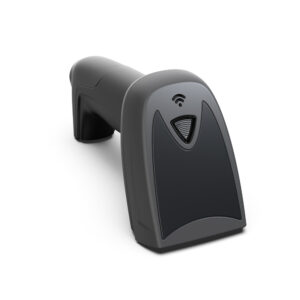
The POS-3230A is the first two. A 2D CMOS imager at 640 × 480 with a 28° × 20° field of view, 115.5 g, wired USB-C with Bluetooth 5.0 as the wireless option, rated for 1.2 m drops. It is a general-purpose handheld for a till that wants to stop being tethered to a cable.
A laser scanner reads a line. A 2D imager reads a picture, and that difference decides which codes you can read at all.
The POS-3230A decodes the full 1D set including Codabar, Code 39, Code 93, Interleaved 2 of 5 and the GS1 DataBar family, and the 2D set including QR, Data Matrix, PDF417, Micro PDF417, Aztec, MaxiCode, HanXin and GS1 Composite. In a shop, the codes that matter beyond the retail EAN are:
If your deployment is retail grocery with nothing but EAN-13, a 1D scanner is cheaper and adequate. If there is a phone screen, a PDF417 document or a DataBar code anywhere in the workflow, the imager is the only one that works.
Published decode ranges are measured on specific test codes, so they read as a jumble. The useful way to look at the POS-3230A’s numbers is by what they mean at the counter:
40 cm on a 13 mil code is the number that stops the “I have to get right up to it” complaint. Combined with 360° roll and ±65° pitch and yaw, staff do not have to orient the label — which in a busy lane is worth more than a small difference in decode speed.
Two figures on this unit are better than the category norm and are worth knowing if your deployment is not a comfortable indoor shop.
Ambient light immunity of 0–100,000 lux. That is direct sunlight at midday. A scanner rated to 10,000 or 20,000 lux works indoors and fails at a market stall, a garden centre, a loading dock with the roller door open, or any counter facing a window. If the scanning position sees the sky, this matters.
Operating range of −20 °C to 60 °C, storage −30 °C to 70 °C at 5–95% non-condensing humidity. Cold-store and outdoor work are inside that envelope. Most handhelds in this price band stop at 0 °C or 50 °C.
Rated 5 V, 75.8 mA standby, 112 mA starting, 136 mA working — modest enough that a wired unit runs from the host’s USB port without a separate supply. That is the advantage of the wired configuration: no battery to manage, no charging discipline, no scanner that dies mid-shift because it went back in the wrong cradle.
Bluetooth 5.0 is the wireless option, and it is worth being clear about when it helps and when it does not:
The physical configuration is fixed at build time, so decide the interface before ordering rather than planning to add it later.
115.5 g in a pistol grip at 156 × 68 × 109 mm. The weight is the point: a scanner is held for eight hours, and the difference between 115 g and 200 g shows up as wrist fatigue by mid-afternoon, not in a specification table.
Rated for 1.2 m drops onto concrete and specified over multiple drops, which is the normal abuse case — a scanner knocked off a counter. The imager window is the part that actually breaks; keep the unit in a holster or on a stand rather than loose on the counter, and the drop rating rarely gets tested.
Yes. A 2D CMOS imager reads emissive screens; a laser scanner cannot. This is the main reason to choose this model over a cheaper 1D unit.
Bluetooth 5.0 is offered as the wireless configuration alongside wired USB-C. The configuration is set at build time, so specify it on the order.
Up to 40 cm on a 13 mil Code 39 label and 37 cm on a 20 mil QR code. Dense small codes read closer — 4–20 cm on 5 mil.
Specified to 100,000 lux ambient light, which covers direct sunlight, and rated from −20 °C to 60 °C. It is not waterproof — there is no IP rating published for this model, so it is not the unit for a wet market or a wash-down area.
No. USB presents as a keyboard (HID) so the host sees scanned codes as typed input, or as a virtual COM port if your software expects one.
12 months minimum. OEM branding and packaging are available — ask at quotation stage.
Next step: tell us the codes you need to read (EAN only, or QR, PDF417, DataBar), whether the scanner stays at a till or moves, and the host platform — we will confirm the interface configuration and quote factory-direct. Email sales@dcapos.com or contact us.
Related: POS-1800A rugged 2D scanner · POS peripherals · POS-8280A desktop imager · POS-2210A wireless scanner · POS systems
|
Dimensions:156.2mm x 68mmx 109.2mm
|
|
Weight:115.5g
|
|
Voltage:5V
|
|
Stand-by Current:75.8mA
|
|
Performance Characteristics
|
|
Image (Pixels):640 pixels (H) x 480 pixels (V)
|
|
Starting Current:112mA
|
|
Work Current:136mA
|
|
Light Source: (Aimer) Red color LED; (Illumination) White color LED
|
|
Field of View:28°(Horizontal),20°(Vertical)
|
|
Roll / Pitch / Yaw:360°, ±65° , ±65°
|
|
Print Contrast:20% minimum reflective difference
|
|
Motion Tolerances:>0.4m/s
|
|
Interfaces Supported:USB
|
|
Symbology Decode Capability
|
|
1-D: Codabar、Code 39、Code 32 Pharmaceutical (PARAF)、 Interleaved 2 of 5、NEC 2 of 5、Code 93、
Straight 2 of 5 Industial、Straight 2 of 5 IATA,Matrix 2 of 5,Code 11、Code 128、GS1-128、UPC-A、UPC-E、EAN/JAN-8、EAN/JAN-13、MSI、GS1 DataBar Omnidirectional、GS1 DataBar Limited、GS1 DataBar Expanded、China Post(Hong Kong 2 of 5)、Korea Post. |
|
2-D: Codeblock A、Codeblock F、PDF417、Micro PDF417、GS1 Composite Codes、QR Code、Data Matrix、
MaxiCode、Aztec、HANXIN. |
|
:Codabar、Code39、 Interleaved2of5、NEC2of5、Code93、Code128、GS1-128、UPC-A、UPC-E0、EAN/JAN-13、
EAN/JAN-8、GS1-DataBar、PDF417、QR、DM、Aztec |
|
User Environment
|
|
Operating Temperature:-20°C to 60°C Storage Temperature:-30°C to 70°C
|
|
Humidity:5% to 95% relative humidity,non-condensing Shock
|
|
Specifications:Designed to withstand 1.2m(5’) drops
|
|
Ambient Light Immunity:0-100,000 Lux.
|
|
Decode Ranges
|
|
Code39(5mil):4-20cm
|
|
Code39(13mil):5-40cm
|
|
QR(20mil):3-37cm
|
|
DM(15mil):3-20cm
|


First time specifying a handheld scanner for the till? Read why a laser cannot read a phone screen before you pick an engine, then what a POS system is made of to see where the scanner plugs in.