When Both Hands Are Already Full
There is a specific moment at a checkout where a handheld scanner stops working as a design: the moment the cashier is holding a bag open with one hand and an item with the other. Reaching for a scanner means putting one of them down, and at 30 items a minute that motion is repeated hundreds of times a shift.
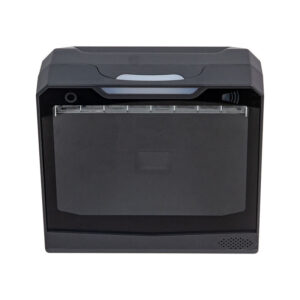
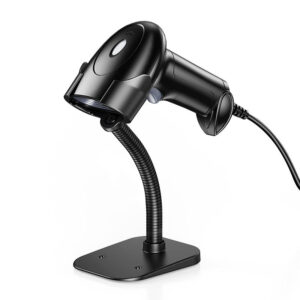
A hands-free scanner removes it. The POS-8230 stands on the counter with a projection window facing up; items are passed over it and read without anyone picking anything up. No trigger, no aiming, no orientation — the cashier’s hands never leave the bag.
The Projection Window and Why It Reads From Any Angle
The scan window is a large flat surface rather than a small lens, and the unit reads through it from multiple angles simultaneously: 360° roll, ±65° pitch, ±60° skew. Practically, that means a code reads whether it is facing up, sideways, or at an angle on a curved pack.
Why this matters more than it sounds:
- No positioning. With a handheld, the operator has to bring the code into a specific cone. With a projection window, an item passed anywhere over the window is in the field of view. The instruction to staff becomes “pass it over the glass”, which is a shorter instruction than any aiming technique.
- Curved and cylindrical packaging. Bottles, tubes and cans put the barcode around a curve, so part of the code is always at an angle. Omnidirectional reading is what stops the “turn the bottle” motion.
- Both orientations at once. A cashier does not have to think about which way the barcode faces, which is where new staff lose time.
The Working Zone: Published Numbers, Not Headline Ranges
Hands-free scanners are usually advertised with a single impressive distance. The number that matters is the one tied to a code size, because depth of field scales with density — a large, coarse code reads much further out than a small dense one.
The published figures for the POS-8230:
- 4 mil Code 39: 40–70 mm. Very small, dense codes read close in and in a narrow band. This is the hardest case and the reason a fixed mounting height needs to be set for the codes actually in use.
- 10 mil Code 39: 10–130 mm. The general retail and carton case.
- 13 mil UPC/EAN: 10–160 mm. The standard product barcode, readable across a 15 cm band above the window.
- 20 mil QR: 10–150 mm. Phone screens and printed QR at similar geometry.
The overall range is quoted as 10–250 mm depending on code size and density. Design a mounting height around the 13 mil figure — 160 mm of working depth is enough to catch an item passed at any reasonable speed and height, and it is the band a cashier naturally uses.
Motion Tolerance: 65 cm/s
The unit decodes at 65 cm/s, which is a genuine continuous swipe rather than a paused presentation. Combined with the 10–160 mm working band on a 13 mil code, that is the combination that makes the hands-free motion feel frictionless: the item passes over the window at the speed of a normal bagging motion and reads.
The sensor is a 640 × 480 global-shutter CMOS with 300,000 pixels, 4 mil resolution at 90% PCS, a print contrast floor of 15%, and ambient light immunity quoted as dark environment to indoor natural light. The 15% contrast floor is worth noting: faded thermal labels and cheaply printed cartons read more reliably than they would on a unit that needs 25–30% contrast.
Bandwidth: The Underrated Constraint at a Bagging Station
A cashier passing items over a window one after another can present them faster than a slow decoder can clear them. Below roughly 40 cm/s the operator has to pace themselves, which is invisible in a specification and obvious in a queue.
At 65 cm/s the scanner keeps up with the motion of bagging. That is the real specification argument for this unit over a cheaper desktop scanner in a both-hands-busy role — the operator is not the bottleneck, and neither is the scanner.
Interfaces and Host Support
USB is standard, with RS232 available as a customised option. On a 1.8 m cable, which is longer than the 1.5 m typical of desk scanners — useful when the unit sits on a bagging shelf away from the terminal.
Supported operating systems are listed as Windows, Linux, Android, iOS and macOS. In practice:
- Windows and Android POS over USB in HID mode, no driver.
- Linux kiosks over HID or, with the RS232 option, as a serial device.
- iOS is listed, and the practical note is the same as for any USB peripheral on an iPad: through a camera adapter or a powered hub, not a bare USB-A port.
Scan modes are automatic, continuous and command-triggered. For a bagging station, automatic is correct — the unit scans whenever something enters the field of view.
Power, Footprint and Volume
5 V DC at 0.5 A input, 115 mA working. The low working current matters for a counter device that is on all day; it means the unit can share a USB port with other peripherals without a powered hub.
Gross weight is 450 g and the package is 170 × 115 × 110 mm. Twenty units fit a 580 × 360 × 240 mm carton at 9.8 kg — a compact pack, which matters for a chain rollout where the scanner ships alongside terminals.
Rated for repeated 1.5 m drops onto concrete. There is no IP rating published, so it is a dry retail counter device rather than a wet or dusty environment unit.
Where the Hands-Free POS-8230 Fits
- Bagging stations. The core case: one hand on the bag, items passed over the window.
- Pharmacy counters. Both hands occupied with medication boxes; a code read hands-free is also a safety check, because the pack stays in view while it is scanned.
- High-volume retail lanes. Where the operator’s motion, not the scanner, should set the pace.
- Kiosks and self-service counters. No trigger to find, no aiming instruction to print.
- Not for reading at distance. 10–160 mm on a 13 mil code. For anything further, use a handheld — POS-3230A reads to 40 cm.
- Not for stocktaking. No battery, no memory, no offline mode — the POS-2210A is the unit for that.
The Desktop Range at a Glance
- POS-8230 — this unit. Hands-free projection window, 10–250 mm, 65 cm/s, USB/RS232, 20 per carton.
- POS-7200 — 120 fps, 44° × 34° FOV, USB-HID/USB-COM/RS232, 1D-only key. The high-throughput checkout unit.
- POS-8800F — 308 g, tilt stand 15–65°, auto-sleep, USB. The customer-facing price checker.
- POS-8280A — compact desktop imager, 35–270 mm, USB HID/CDC/HID-POS.
Frequently Asked Questions
Does it work without a button?
Yes. In automatic mode it scans whenever a code enters the field of view above the window. There is no trigger to press.
How high above the window should an item be?
For a standard 13 mil retail barcode, anywhere from 10 to 160 mm above the glass. Mount or place the unit so that band is where the operator naturally passes items.
Can it read a QR code on a phone screen?
Yes. 2D coverage includes QR, PDF417 and Data Matrix, with a 20 mil QR code readable from 10 to 150 mm.
Does it need a driver?
No, in USB HID mode. The RS232 option presents a serial stream for kiosk controllers.
Is it waterproof?
No IP rating is published for this model. It is a dry counter device; for a wet or dusty environment a protective enclosure is the practical answer, which we can quote.
What is the warranty?
12 months minimum. OEM branding, packaging and pre-set scan mode are available — ask at quotation stage.
Next step: tell us the station (bagging, pharmacy, kiosk), the mounting position and the host platform — we will confirm the interface and mounting hardware, and quote factory-direct. Email sales@dcapos.com or contact us.
Related: POS-1800A rugged 2D scanner · POS peripherals · POS-7200 desktop scanner · POS-8800F price checker · POS systems
|
Model
|
POS-8230
|
|
Color
|
Black
|
|
Interfaces
|
USB,RS232(customized)
|
|
Cable
|
1.8M
|
|
Reading Indicators
|
LED/Buzzer
|
|
Input Voltage
|
5 VDC/0.5A
|
|
Current
|
115mA(Working)
|
|
OS Support
|
Microsoft Windows/Linux/Android/IOS/MacOS
|
|
Drop resistance
|
Withstands repeated drops from 1.5m/4.0 ft onto a concrete surface
|
|
Performance
|
|
|
Sensor
|
CMOS global shutter
|
|
Pixel
|
300,000(640*480)
|
|
Reading Precision
|
≥4mil(PCS90%,CODE 39)
|
|
Depth of Field
|
10mm~250mm(Different bar code range)
|
|
Decoding Speed
|
65CM/S
|
|
Illumination
|
Red LED
|
|
Scanning mode
|
Auto,continuous,command ( USB COM or RS232)
|
|
Reading Angle
|
Roll:±360°,Pitch:±65,Skew:±60°
(Test ConditionsCODE39,10mil/0.25mm,PCS90%)
|
|
Print contrast ratio
|
≥15%
|
|
Ambient Illumination
|
Dark Environment,Indoor Natural Light
|
|
Typical depth of Filed
|
Precision Barcode Depth of Filed
4mil CODE39 40mm—70mm
10mil CODE39 10mm—130mm
13mil UPC/EAN 10mm—160mm
20mil QR code 10mm—150mm
etc…..
(The minimum depth of field is determined by the barcode length and scanning angle. It depends on the print resolution, contrast
and ambient light.)
|
|
Decoding ability
|
1D:UPC-A,UPC-E,EAN-8,EAN-13,ISBN,ISSN,Code 128, GS1-128,ISBT, Code 39,Code 32, Code 93,Code 11,Codabar(NW-7),Interleaved 2 of
5,Matrix 2 of 5,Industrial 2 of 5(Straight 2 of 5),Standard 2 of 5(IATA 2 of 5),NEC 2of 5, MSI,Telepen, Trioptic,BC412 ,Coupon.
2D: QR Code,Micro QR Code,Data Matrix,PDF417,Micro PDF 417, MaxiCode,Aztec,HanXin Code,Pharma Code(One-Track),Codablock
A,Codablock F, Dot Code, Grid Matrix, etc.
Other composite code:GS1 Databar(Omnidirectional, Limited, Expanded),GS1 Composite Code, TLC 39 Code. Chinese ID Card OCR , etc.
Postal code:HongKong 2 of 5(China Post), Korea Post, Australian Post, British Post, USPS Intelligent Mail, Japanese Post, Planet
Code, Postnet Code, UPU 4-State, KIX Code
|
|
Physical
|
|
|
Weight
|
Gross:450g
|
|
Package
|
170*115*110mm
|
|
20 in 1 carton
|
580*360*240mm/9.8kg
|
|
Environment
|
|
|
Working temperature& humidity
|
0 to 45 degrees centigrade, 10%~80% No condensation
|
|
Storage temperature& humidity
|
-20 to 60 degrees centigrade , 10%~90% No condensation
|