If you want more information of our industry and products,please contact us.
Get to Know Us Now
Most dual-screen POS setups are a terminal plus a bracket plus a second monitor, with a video cable, a second power supply and a mounting arm. It works, and it is three items to install and four things that can come loose.
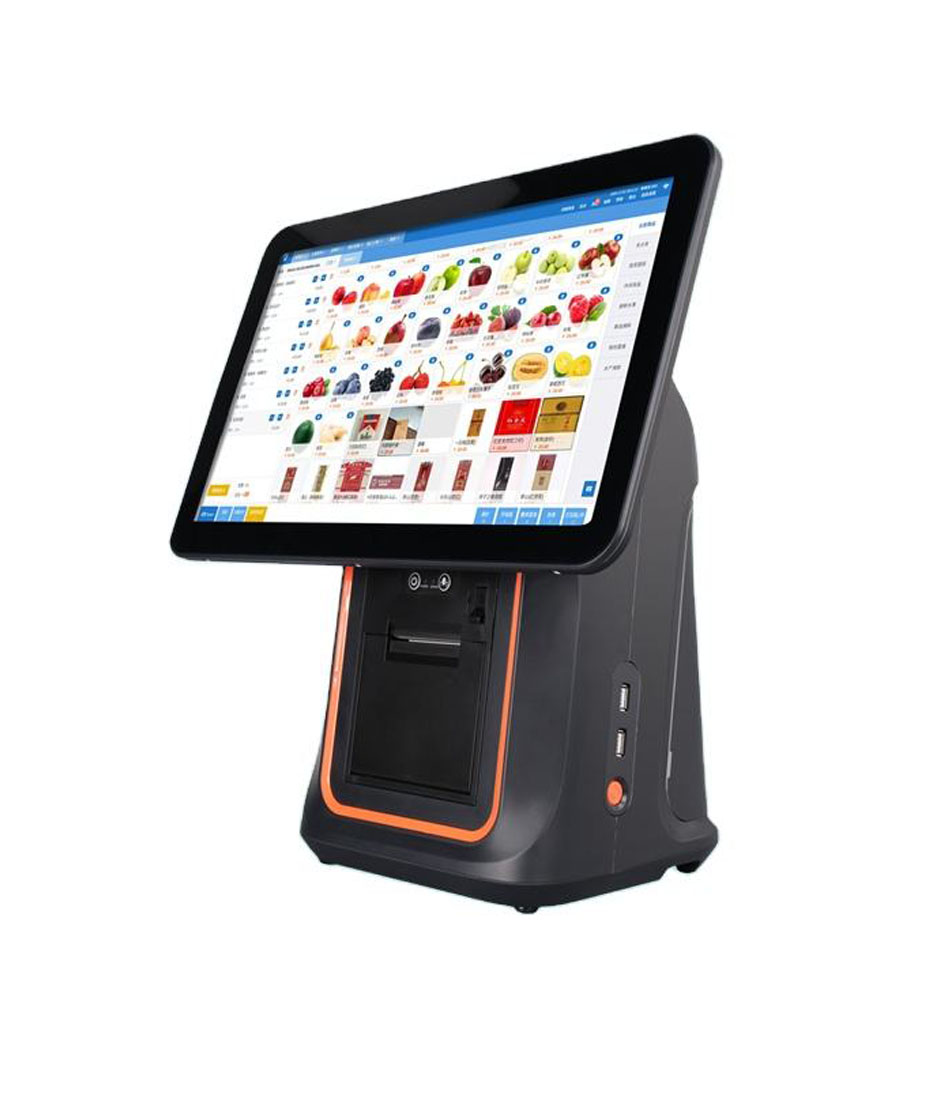
The DCA-151WS is the integrated version: a 15-inch main touchscreen with a second customer-facing display built onto the front of the same aluminium chassis. One power lead, one housing, one thing to mount.
The main panel is 15 inches at 1024 × 768 — a 4:3 aspect ratio, not 16:9.
That is deliberate, and it is the specification that decides whether the terminal suits an existing application. A large share of POS software was laid out for 1024 × 768: a product grid of six columns, a cart panel on the right, function keys along the bottom. Port that layout onto a 1366 × 768 widescreen and the vertical space for the cart shrinks by a quarter, so either the item list shows fewer lines or the design has to be reworked.
On a 4:3 1024 × 768 panel, the layout the software was designed around fits exactly. For a site migrating hardware but keeping its application, that is worth more than the extra horizontal centimetres of a widescreen.
Brightness is 300 or 350 nits depending on configuration — bright enough for a shop interior, not for direct sunlight — and the touch layer is projected capacitive.
The second display is a 9.7 or 12-inch panel facing the customer, with a touch option on the second display.
A front-facing display at this size changes what the customer sees. A 2 × 20 character display shows a total; a 9.7-inch panel shows the itemised basket with product names, the running total, and — if the software supports it — a logo, a promotion or a payment prompt. For a site where the customer wants to see what they are being charged for, the difference is significant.
The touch option on the second display is only worth specifying if there is something for the customer to do: a signature, a tip selection, a satisfaction prompt, a loyalty sign-up. A touch layer on a display that only shows a total adds cost, reduces brightness and creates a surface that gets touched with wet or sticky hands for no reason.
The platform is the Windows industrial board used across this chassis family: Intel Celeron J1900 at up to 2.42 GHz, J3455 at up to 2.30 GHz, or a Core i3/i5 option.
Memory is 4 GB DDR3L or DDR4 depending on configuration, expandable to 8, 16 or 32 GB; storage is mSATA or M.2 from 32 GB to 512 GB, with an optional 2.5-inch SATA SSD or a 500 GB / 1 TB hard disk.
Operating systems supported are Windows 7, 10, 11 and POSReady. For a new deployment, Windows 10 IoT / LTSC is the version to specify: long-term servicing, security patches only, no feature updates arriving on a trading terminal. POSReady appears in the list because a large installed base of POS software was certified against it, and that certification is often what a support contract rests on.
One VGA output, or VGA plus HDMI; six external USB ports; one RJ45; two RS232 COM ports; line out and mic in; an optional RJ11 cash drawer port.
Two native COM ports matter for the same reason they always do: a customer display, a scale, an older printer or a payment terminal on serial does not enumerate as USB and does not change COM number after a reboot. Six USB ports cover the rest.
Cooling is fanless or fan-assisted depending on the CPU. The chassis is full aluminium alloy including the base, at 360 × 380 × 210 mm and 5.10 kg net for the single-display build, packed at 430 × 450 × 290 mm and 7.50 kg. VESA 75 × 75 and 100 × 100 mounting is available on the single-display configuration, which is what allows the unit to be fixed to a wall or an arm rather than standing on the counter.
Power is 100–240 V AC in, 12 V / 5 A DC out. Operating range 0–50 °C, storage −20 to 60 °C — a wider operating envelope than the plastic-chassis units in the range, which is a consequence of the aluminium housing.
Options include an ISO three-track MSR, a Mini-PCIe Wi-Fi module, Bluetooth 4.0, a 4 Ω / 3 W speaker and a VFD220 customer display.
A second display is available as a 9.7 or 12-inch panel with an optional touch layer. Specify it in the configuration; it is not a field addition.
Because 4:3 is the layout most POS software was designed for. If the application is widescreen-native, a 15.6-inch 1366 × 768 model in the range is the better choice.
Yes — VESA 75 × 75 and 100 × 100 on the single-display configuration, with a bracket.
Windows 10 IoT / LTSC for a new deployment. POSReady is listed for applications certified against it.
Two RS232, plus six USB and one VGA (or VGA and HDMI).
12 months minimum. OEM branding, colour, pre-installed image and OS build are available — ask at quotation stage.
Next step: tell us the POS application and the screen resolution it was designed for, whether the second display needs touch, and the mounting position — we will confirm the configuration and quote factory-direct. Email sales@dcapos.com or contact us.
Related: DCA-Q3S dual-screen Windows POS · POS systems · DCA-152W foldable stand POS · DCA-KSW with printer · all products


First time specifying a Windows POS terminal? Read what a POS system is made of before you compare model numbers, then what all-in-one actually integrates to see what the built-in printer changes.