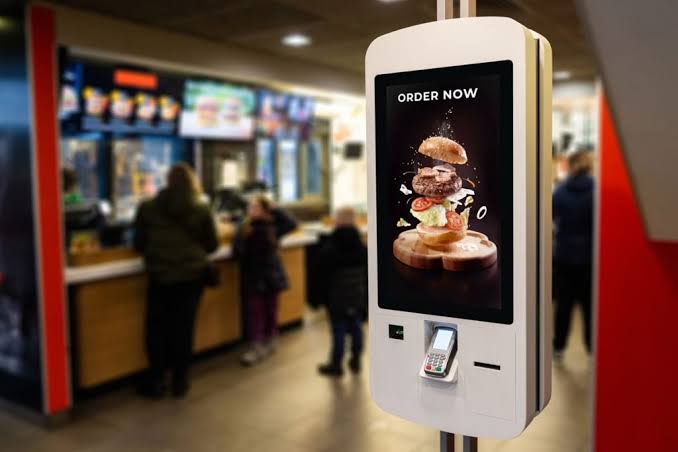
AI-powered self-ordering kiosks are becoming an important part of modern restaurant technology. Traditional kiosks already allow customers to browse menus, customize meals, place orders, and pay without waiting for a cashier. The next step is adding AI to make the ordering experience more personalized, responsive, and connected to restaurant operations.
In 2026, the opportunity is moving beyond simply replacing a cashier with a touchscreen. AI can help restaurants recommend products, optimize upselling, understand customer behavior, and connect kiosk ordering with POS, inventory, loyalty, and kitchen systems.
For restaurant operators, however, the most important question is not whether a kiosk has an “AI” label. The real question is:
Can AI make the ordering process easier for customers while creating measurable value for the restaurant?
This article explores how AI-powered self-ordering kiosks work, their key benefits, the role of POS hardware, and what restaurants should consider before deployment.
What Is an AI-Powered Self-Ordering Kiosk?
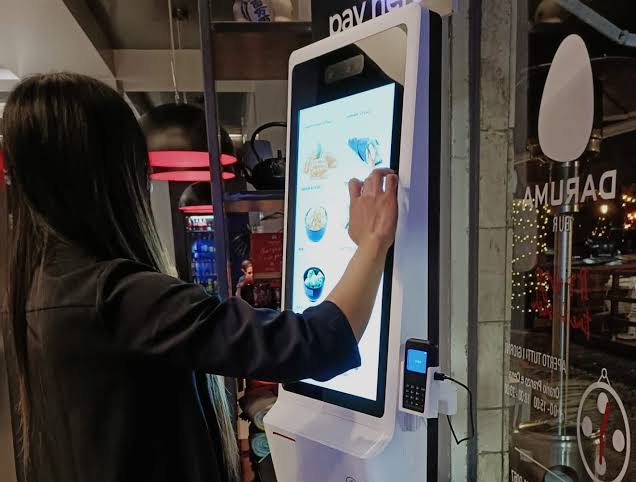
A traditional self-ordering kiosk is a touchscreen system that allows customers to:
- Browse a digital menu
- Select products
- Customize orders
- Add extras
- Review their order
- Make a payment
- Receive an order confirmation
An AI-powered self-ordering kiosk adds intelligent software to this process.
Instead of showing exactly the same menu path to every customer, AI can analyze the customer’s current order and available restaurant data to provide more relevant recommendations.
For example, after a customer selects a burger, the kiosk might recommend:
“Make it a combo?”
Or:
“Add a drink and fries?”
The objective is not to make ordering more complicated. It is to make recommendations more relevant and useful.
Why Self-Ordering Kiosks Are Growing in Restaurants
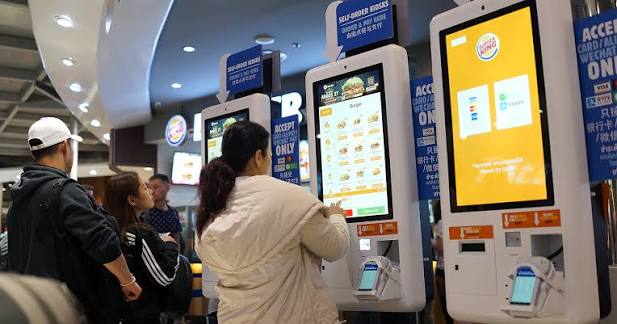
Self-service has become an important part of restaurant technology, particularly for quick-service and high-volume environments.
Recent industry research describes self-ordering kiosks as increasingly important in QSR and other hospitality environments, driven by pressure to improve ordering speed, operational efficiency, and customer convenience.
The technology can be especially useful during peak periods.
Imagine a restaurant with three traditional cashiers.
During lunch:
Customer → Queue → Cashier → Order → Payment
With self-ordering kiosks:
Customer → Kiosk → Order → Payment
Multiple customers can place orders simultaneously.
This can reduce pressure on the front counter and allow employees to focus on food preparation, customer service, and other operational tasks.
1. AI Can Provide Smarter Product Recommendations
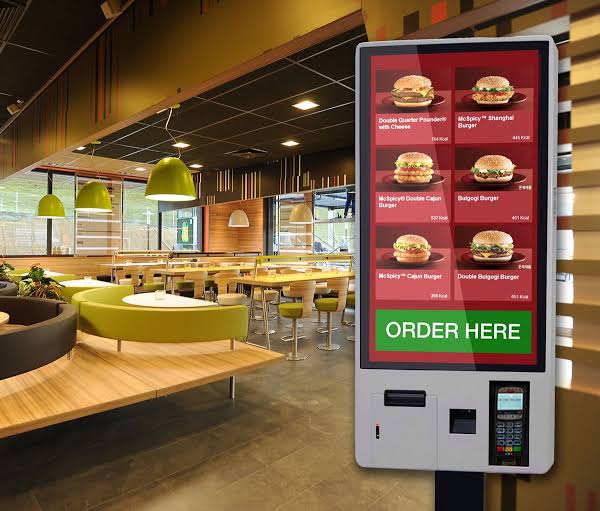
One of the most practical AI applications is intelligent upselling.
Traditional kiosks often use fixed recommendations:
“Add fries?”
AI can potentially make recommendations based on:
- Current order
- Product combinations
- Previous purchasing patterns
- Time of day
- Promotions
- Menu configuration
For example:
A customer orders a chicken burger.
The system recognizes that this item is frequently purchased with fries and a soft drink.
Instead of displaying a random promotion, the kiosk can recommend the relevant combination.
AI-powered kiosk providers are already positioning smart recommendations and AI upselling as core features of their systems.
2. AI Can Help Increase Average Order Value
A successful kiosk should do more than process orders.
It should also help restaurants create better sales opportunities.
AI can potentially recommend:
- Combos
- Side dishes
- Drinks
- Desserts
- Add-ons
- Premium upgrades
For example:
Customer order:
Burger + fries
AI recommendation:
“Add a drink for $2?”
The recommendation is presented at the appropriate stage of the ordering process.
Unlike a human cashier, the system can make the recommendation consistently for every customer.
3. AI Can Make Menu Navigation Easier
Large restaurant menus can sometimes overwhelm customers.
A customer may need to navigate through:
- Categories
- Subcategories
- Product variations
- Sizes
- Add-ons
- Meal combinations
AI can help simplify this experience.
A future AI-enabled kiosk could allow customers to describe what they want using natural language.
For example:
“I want a spicy meal without dairy.”
The system could identify relevant products based on the restaurant’s menu rules.
This can make the kiosk more conversational while still keeping the restaurant’s approved menu structure.
However, restaurants should ensure that AI recommendations remain connected to the actual menu and product availability.
4. AI Can Support Multilingual Ordering
Restaurants in airports, shopping centers, tourist areas, and international markets often serve customers who speak different languages.
A digital kiosk can provide multiple language options.
AI can take this further by helping customers interact with the system using more natural language.
Potential applications include:
- Automatic language detection
- Multilingual product descriptions
- Natural-language search
- Voice-assisted ordering
- Translation assistance
This can make self-service more accessible to international customers.
5. AI Can Connect Ordering With Inventory
One of the biggest opportunities is connecting the kiosk with restaurant operations.
A modern restaurant technology ecosystem can connect:
Kiosk
↓
POS
↓
Kitchen Display System
↓
Inventory
↓
Analytics
When these systems communicate correctly, the kiosk can work with current menu and inventory information.
For example, if a product becomes unavailable, the system should be able to remove or disable that item instead of allowing customers to order something the kitchen cannot prepare.
This is one reason POS integration is more important than AI features alone.
6. AI Can Help Restaurants Understand Customer Behavior
Every kiosk transaction creates useful operational data.
Restaurants can analyze:
- Popular products
- Average order value
- Product combinations
- Peak ordering periods
- Add-on acceptance
- Menu navigation
- Promotion performance
AI can identify patterns within this information.
For example:
Customers ordering Product A are frequently interested in Product B.
The restaurant can then test a new combo or recommendation.
This turns the kiosk into more than an ordering terminal.
It becomes another source of business intelligence.
7. AI Can Improve the Customer Experience Without Removing Human Staff
AI-powered kiosks do not necessarily mean eliminating human interaction.
In many restaurants, the better approach is to let technology handle repetitive ordering tasks while employees focus on areas where human interaction provides more value.
For example:
Kiosk
- Takes orders
- Processes payments
- Recommends products
- Sends orders to the kitchen
Restaurant Staff
- Helps customers
- Handles special requests
- Prepares food
- Manages the dining area
- Resolves problems
This creates a hybrid operating model rather than a completely automated restaurant.
8. AI Can Help During Peak Hours
Peak periods are one of the strongest use cases for self-ordering technology.
During lunch or dinner rushes, restaurants may experience:
- Long queues
- Increased order errors
- Pressure on cashiers
- Slower service
Multiple kiosks can allow several customers to order simultaneously.
This parallel ordering model is one reason self-ordering kiosks are increasingly being considered as part of restaurant front-of-house infrastructure.
AI can then add another layer by helping customers navigate menus and discover relevant products.
9. AI-Powered Kiosks Need Reliable POS Integration
A kiosk should not operate as an isolated machine.
Ideally, it should connect directly with the restaurant’s POS ecosystem.
A typical workflow could look like:
Customer
↓
AI Self-Ordering Kiosk
↓
Restaurant POS
↓
Kitchen Display System
↓
Kitchen
↓
Order Completed
The POS remains the central operational system, while the kiosk becomes another ordering channel.
This approach can help restaurants maintain consistent:
- Prices
- Menu items
- Promotions
- Taxes
- Inventory information
- Order records
Modern restaurant technology increasingly emphasizes connecting multiple ordering channels rather than operating separate systems.
10. The Hardware Behind an AI Self-Ordering Kiosk
AI is primarily a software capability, but the hardware still matters.
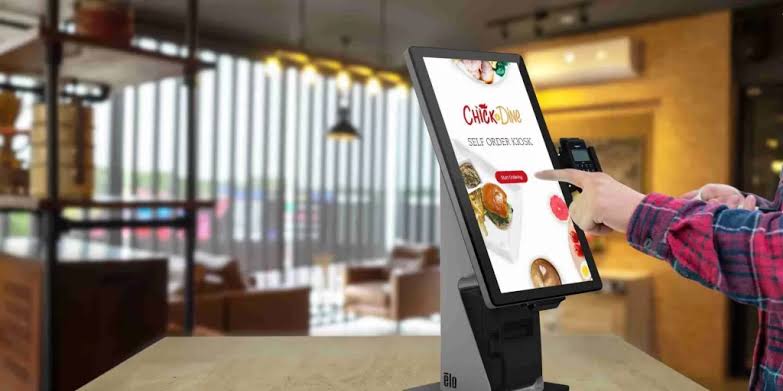
A commercial self-ordering kiosk typically requires:
- Large touchscreen
- Commercial-grade processor
- RAM and storage
- Wi-Fi
- Ethernet
- USB interfaces
- Payment-device connectivity
- Printer support where required
- Optional barcode or QR scanner
- Optional NFC reader
- Secure mounting structure
For AI-enabled applications, processor selection becomes even more important.
Depending on where the AI processing takes place, the hardware may need sufficient CPU or AI acceleration capabilities.
11. Edge AI vs Cloud AI
Not all AI processing needs to happen on the kiosk.
There are two major approaches.
Cloud-Based AI
The kiosk communicates with cloud services for AI processing.
Advantages can include:
- Powerful computing resources
- Centralized management
- Easier model updates
- Multi-store data analysis
This approach is suitable for many analytics and recommendation applications.
Edge AI
Some AI processing takes place locally on the kiosk.
Potential advantages include:
- Faster response
- Lower network dependency
- Local processing
- Better responsiveness for certain applications
For hardware manufacturers, edge AI creates new requirements for processor performance, memory, thermal design, and system optimization.
12. Security and Privacy Should Be Part of the Design
Restaurants should not treat AI as only a marketing feature.
Customer and transaction data need to be handled carefully.
Before deploying an AI kiosk, businesses should understand:
- What data is collected?
- Where is the data processed?
- What information is stored?
- Who can access the data?
- How long is it retained?
- How does the system communicate with the POS?
AI features should be designed around the restaurant’s actual data and security requirements.
13. What Should Restaurants Look for When Buying an AI Kiosk?
Before purchasing, restaurant operators should evaluate the entire system rather than only the screen size or AI features.
Hardware
Look at:
- Screen size
- Touch technology
- CPU
- RAM
- Storage
- Connectivity
- Payment integration
- Durability
- Thermal management
Software
Look at:
- POS integration
- Menu management
- AI recommendations
- Promotions
- Loyalty integration
- Analytics
- Remote management
- Multilingual support
Manufacturing
For large deployments, also consider:
- Product lifecycle
- OEM/ODM capability
- Spare parts
- Firmware support
- Reliability testing
- Certification
- Production capacity
14. Don’t Buy an “AI Kiosk” Just Because It Has AI
This is perhaps the most important point.
The word AI is increasingly used in restaurant technology marketing.
But restaurants should ask practical questions:
What does the AI actually do?
Does it improve ordering?
Can it increase relevant upselling?
Does it connect to our POS?
Does it work with our existing menu?
Can the manufacturer support the hardware for several years?
A kiosk with a powerful AI demo but poor POS integration may provide less business value than a simple, reliable kiosk that works seamlessly with the restaurant’s existing infrastructure.
15. The Future of AI-Powered Restaurant Kiosks
The next generation of restaurant kiosks is likely to become increasingly intelligent.
Instead of:
Browse → Select → Pay
the experience may evolve toward:
Understand → Recommend → Personalize → Order → Pay
AI could help the kiosk understand customer preferences while the POS system continues to manage the operational side of the restaurant.
The most successful systems will likely combine:
- Reliable commercial hardware
- Strong POS integration
- Intelligent recommendations
- Accurate menu data
- Secure payment
- Real-time inventory information
- Centralized management
AI Kiosks Are Becoming Part of a Larger Restaurant Ecosystem
The future is not simply about putting AI into a kiosk.
It is about creating a connected restaurant technology ecosystem.
A restaurant may eventually operate:
AI Self-Ordering Kiosks
Android POS Terminals
Kitchen Display Systems
Receipt Printers
Customer Displays
Payment Devices
Inventory Management
Loyalty & CRM
AI Analytics
All of these systems need to work together.
For this reason, POS hardware manufacturers and restaurant software companies will increasingly need to collaborate during product development and system integration.
Final Thoughts
AI-powered self-ordering kiosks are changing the role of self-service technology in restaurants.
Traditional kiosks focused primarily on allowing customers to place orders without a cashier.
AI introduces a new possibility: making the ordering experience more intelligent and personalized.
AI can help restaurants:
- Recommend relevant products
- Improve upselling
- Simplify menu navigation
- Support multilingual ordering
- Analyze customer behavior
- Connect ordering with inventory
- Improve operational efficiency
But AI should not be viewed as a replacement for reliable POS infrastructure.
The foundation remains the same:
Reliable hardware + stable software + strong POS integration + useful AI.
For restaurants planning their next self-service project, the goal should not simply be to buy the most advanced AI kiosk.
The goal should be to build a reliable, scalable ordering platform that can evolve as restaurant technology continues to develop.
At DCAPOS, we see the future of self-service as a combination of commercial POS hardware, intelligent software, and seamless system integration—creating technology that doesn’t just take orders, but helps restaurants operate smarter.