Every buyer arrives at a supplier meeting with a list of questions, and almost every list fails for the same reason: it does not say what a bad answer sounds like. “Do you have your own R&D team” is answered yes by a company with two application engineers and by a company with forty hardware engineers, and the two answers are indistinguishable.
So this is not a list of fifteen questions. It is fifteen questions with the answer that means nothing next to the answer that means something, grouped by what they are actually testing: whether the supplier designs, whether it controls quality, whether it will still exist in five years, and whether it will answer the phone in year three.
Questions about who actually designs the product
Four questions establish whether you are talking to a designer or a reseller. The tell is never the org chart; it is whether the answer contains a specific artefact you could ask to see.
| Question | Means nothing | Means something |
|---|---|---|
| Do you have your own R&D team? | “Yes, we have a strong engineering team.” | “Fourteen people: six hardware, four firmware, two mechanical, two test. The mechanical team is in the same building as the tool shop.” |
| Do you support both OEM and ODM? | “Yes, we support all kinds of customisation.” | “ODM on our platform from 500 units. OEM only if you own the tooling, because we will not cut steel for a design we did not validate.” |
| How many years have you been building POS? | “More than fifteen years of experience.” | A model history: which models shipped in which year, and which are still supported. Age without a product list is a trading company. |
| Who writes the firmware? | “We have a professional software team.” | A named person, a build number scheme, and the answer to “what happens to my firmware when the SoC goes end-of-life”. |
The fourth question is the one that separates a manufacturer from an assembler. A company that buys finished boards and installs them cannot fix a driver, and a POS terminal is mostly drivers: printer timing, drawer pulse, scanner enumeration, touch parameters. If the answer to “who writes the firmware” is vague, every peripheral problem in year two becomes a conversation with a third party you have no relationship with.
Questions about how quality is controlled
This block is where a prepared supplier shines and an unprepared one improvises. The rule is that a real process produces a document, and the document has numbers on it.
| Question | Means nothing | Means something |
|---|---|---|
| What quality system do you run? | “We have strict quality control at every step.” | “ISO 9001 since 2016, IQC and IPQC gates, AQL 0.65 major at FQC, and a Pareto of returns reviewed monthly.” |
| Do you test 100% of units? | “Yes, every unit is fully tested before shipping.” | “Every unit runs a 90-second functional program and 48 hours of burn-in at 45 °C. First-pass yield last month was 97.4%.” |
| Can you do reliability testing in house? | “Yes, we have a professional laboratory.” | Named equipment: a thermal chamber with a stated range, a drop rig, an ESD simulator to IEC 61000-4-2, and a burn-in rack with a stated unit count. |
| How do you trace a failure? | “Every product has a unique serial number.” | “The serial returns assembly date, station, operator, panel lot, battery lot, firmware version and the test log. A field failure is contained to a lot within a day.” |
Note what makes the good answers good: they contain a number the supplier could not have guessed you wanted. A first-pass yield figure quoted without being asked is the strongest single signal available in a supplier meeting, because a company that measures it is a company that has been embarrassed by it.
Questions about continuity
A POS deployment is a five-to-ten-year commitment and the purchase decision is made in year zero. These four questions are about year five, and they are the ones most buyers forget to ask because they are not about the product in the room.
| Question | Means nothing | Means something |
|---|---|---|
| Can you guarantee long-term component supply? | “We have stable suppliers and long-term cooperation.” | A named panel part number with its lifecycle status, and a five-year spare parts horizon with a published price list. |
| What happens when a model is discontinued? | “We will always provide the best replacement.” | “Twelve months written notice, a last-time-buy window at the last published price, and packs and display assemblies kept for five years after the final shipment.” |
| Which certifications can you support? | “CE, FCC, RoHS, all certificates available.” | “CE EMC and safety in our name or yours, FCC grant reference, UN38.3 for the pack. Here is the technical file structure, and here is what a design change would invalidate.” |
| Can you customise the Android firmware? | “Yes, we can do any customisation.” | “AOSP build with our board support, signed with our key or yours. Customisation is limited to what survives an OTA: preinstalled apps, kiosk mode, boot animation, peripheral settings.” |
The firmware answer is worth dwelling on because it is where expectations usually break. Almost any supplier can preinstall an application. Very few will give you the signing key, and without it you cannot ship an update to your own devices — every firmware change routes through the factory, on their schedule, forever.
Questions about year three
Three questions decide what happens when something fails, which is the only part of the relationship that will be judged by your customer rather than by you.
| Question | Means nothing | Honest answer |
|---|---|---|
| What is the warranty and what does it cover? | “Two years, full warranty, no problem at all.” | “Twelve months from arrival, parts and labour, excluding the print head and the battery as wear items — and here are their prices.” |
| How fast do you answer a support ticket? | “We reply immediately, 24 hours a day.” | “Four working hours for a first response, one working day for a fault analysis, and here is the escalation path with names.” |
| Can I visit the factory? | “Of course, you are always welcome.” | “Any working day, and we will walk the line, the aging rack and the IQC area. We would rather you came before the order than after.” |
The middle column of that table is the honest one, and it is the column buyers distrust on first reading. A supplier who excludes the print head from warranty is telling you that the print head is a consumable with a finite life, which is true, and that they have priced it, which is useful. A supplier who warrants everything for two years is either building a product with no wear items, which does not exist, or planning to argue about it later.
The three answers that only exist on site
Some questions cannot be answered in a meeting room, and a supplier who discourages a visit is answering one of them by accident. Three things are worth looking at directly.
- The aging rack, running. Count the units in it and look at the date on the log sheet. An empty rack with a printed procedure taped to the wall is a rack that is not used.
- The IQC area, with parts in it. A real IQC station has a limit-sample board, a colour booth, and rejected material in a red bin with a disposition tag. An empty bench with a laminated flowchart is a photograph of a process.
- Who answers the technical questions. If every question routes through a salesperson who leaves the room to ask someone, the engineering team is not in the building, and the factory is an assembly line with a showroom in front of it.
How to score the meeting
Fifteen questions produce a lot of words and very little structure. A simple scoring scheme fixes that: one point per question where the answer contained an artefact you could ask to see — a number, a part number, a date, a document — and zero where it contained an adjective.
| Score | What it means | What to do |
|---|---|---|
| 10–15 | The supplier measures its own process | Ask for the documents and check two of them |
| 6–9 | Some process, inconsistently documented | Buy a sample lot before a production order |
| 3–5 | A reseller with a showroom | Fine for private label, wrong for a custom build |
| 0–2 | Nothing was measured | The answers will be the same next year, whatever happens in between |
The score is not a judgement of the company. A trading company scoring four is a perfectly good supplier of a private-label terminal at a hundred units, and a bad partner for a project that needs a driver written. What the score tells you is which of those two conversations you are in.
Red flags that are not in any answer
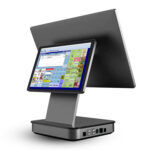
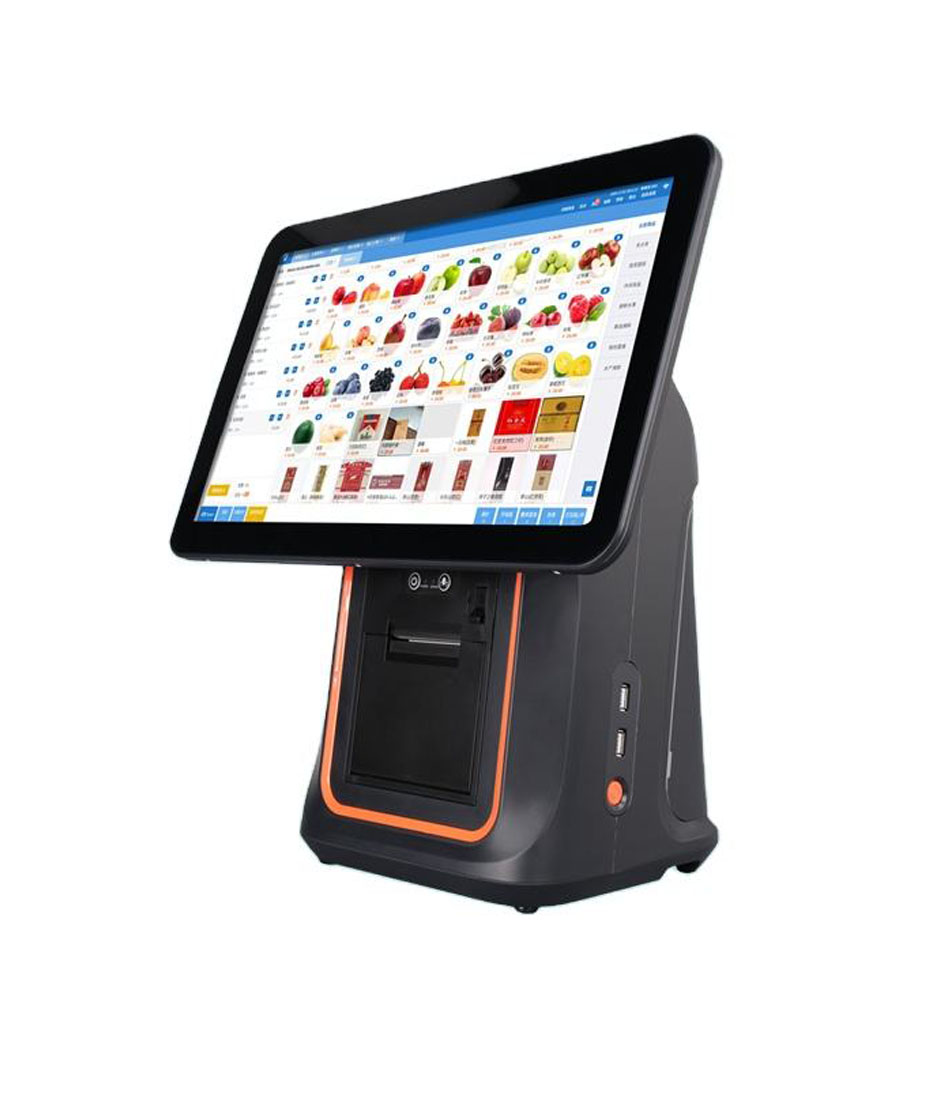
Some signals are structural rather than verbal, and they are more reliable than anything said in the meeting. A quotation that arrives within two hours, before anyone has asked what you need, is a price list rather than an answer. A datasheet with no model number is a marketing document. A real one carries the model and the numbers with units: the 156A sheet states 1366 by 768, 250 nits and four USB ports including one OTG, and the 8250 sheet states 576 dots a line and 260 mm a second. A supplier who says yes to every customisation request has not understood the request, because at least one of them requires a new mold.
The strongest negative signal is a warranty longer than the industry with no exclusions and no increase in price. Wear items exist, batteries age, print heads wear out; a warranty that pretends otherwise is priced for the argument rather than the repair.
FAQ
How many suppliers should I shortlist?
Three. One incumbent or reference, one that was recommended, and one that is unfamiliar. The unfamiliar one is where you learn what the market currently charges, and the comparison is only meaningful if all three are asked the same questions in writing.
Should I ask for references?
Yes, and ask for references in your own region and your own vertical. A reference from a large European chain tells you the factory can pass an audit; a reference from a twenty-site restaurant group tells you what the support is like when something goes wrong on a Friday night.
What is the single best question?
“What failed on the last hundred units you shipped, and what did you change?” It cannot be answered from a brochure, and the answer reveals whether anyone is measuring.
Where to go next
Fifteen questions, one meeting, and the answers you can check afterwards. For the documents behind them:
OEM and ODM: who owns the tooling what AQL and traceability actually mean the six test benches how to read the quotation that follows who makes which part, and where the clauses that cover year five · what a POS system is made of · what a quote should break out, line by line
Specifying the hardware? The hardware side is covered in the POS system, by counter position — where each part sits and which of them you can stop buying separately.