When purchasing a commercial POS system, most buyers compare specifications such as CPU, memory, display size, and price.
However, these specifications reveal only part of the story.
The true quality of a POS terminal depends on what happens inside the factory long before the product reaches the customer.
A reliable commercial POS system is the result of disciplined quality control throughout every stage of manufacturing—from incoming material inspection to final shipment.
In this article, we’ll take you inside a professional POS factory and explain how quality control works to ensure every touch screen POS system meets the demands of real-world commercial environments.
Why Quality Control Matters for Commercial POS Systems
Unlike consumer electronics, POS terminals are designed for continuous daily operation.
Many devices work:
- 10–16 hours per day
- 7 days a week
- In restaurants with heat and grease
- In supermarkets with heavy customer traffic
- In retail stores with constant transactions
Even a minor hardware issue can interrupt business operations, delay customer service, and increase maintenance costs.
This is why commercial-grade POS manufacturers invest heavily in quality assurance rather than relying solely on final product inspections.
Quality is built into every production stage—not inspected in at the end.
Step 1: Incoming Quality Control (IQC)
Quality begins before production starts.
Every batch of incoming components is inspected before entering the warehouse.
Typical inspections include:
LCD Displays
Inspect for:
- Dead pixels
- Brightness consistency
- Color uniformity
- Surface scratches
Touch Panels
Verify:
- Touch sensitivity
- Response accuracy
- Glass integrity
- Optical bonding quality
Motherboards
Check:
- Component placement
- Solder quality
- Firmware version
- Boot functionality
Plastic and Metal Parts
Inspect for:
- Dimensions
- Surface finish
- Color consistency
- Warping or deformation
Components that fail inspection are rejected before production begins.
This prevents defective materials from entering the assembly line.
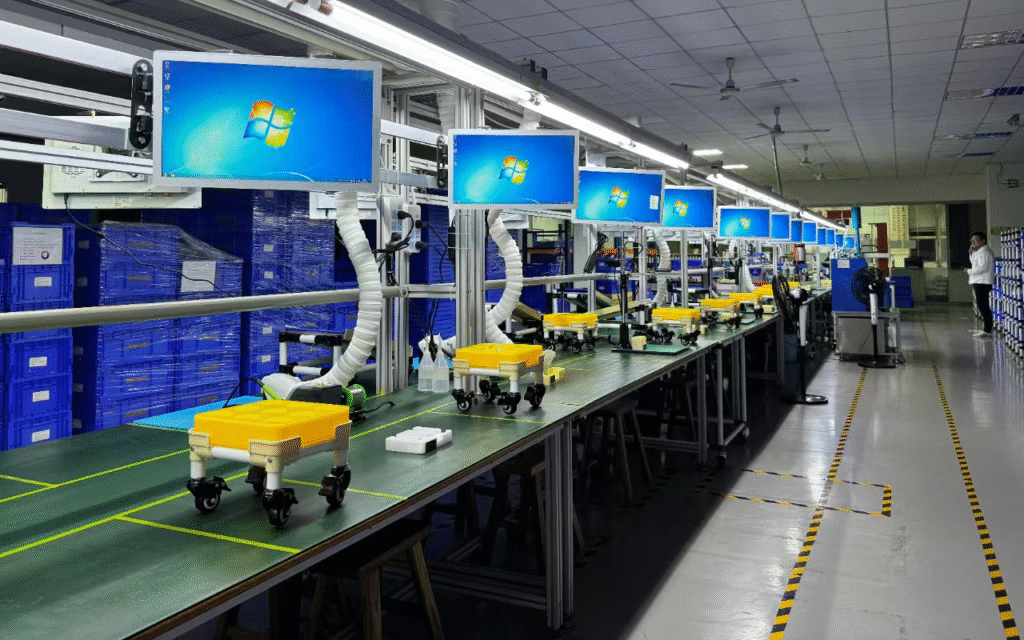
Step 2: Production Line Process Control (IPQC)
Once assembly begins, quality inspectors monitor every manufacturing process.
This stage is known as In-Process Quality Control (IPQC).
Instead of waiting until the product is finished, inspectors continuously verify assembly quality.
Typical checkpoints include:
- Screw torque verification
- Cable routing
- Connector installation
- Display alignment
- Touch panel bonding
- Internal wiring
This helps identify production issues immediately before they affect larger batches.
Step 3: Functional Testing
Every assembled POS terminal undergoes comprehensive functional testing.
Engineers verify that all hardware components operate correctly.
Typical tests include:
Touchscreen Test
Verify:
- Multi-touch response
- Edge accuracy
- Gesture recognition
- Touch sensitivity
Display Test
Check:
- Brightness
- Contrast
- Uniformity
- Backlight stability
Peripheral Interface Test
Each interface is verified:
- USB
- LAN
- HDMI
- Serial ports
- Audio
- Cash drawer interface
Every communication port must operate according to specification.
Step 4: Android or Windows System Verification
Hardware alone is not enough.
The operating system is also tested.
Typical verification includes:
- Boot time
- Application compatibility
- Wi-Fi stability
- Bluetooth connectivity
- USB recognition
- Camera functionality (if applicable)
- NFC operation (if equipped)
Long-duration testing helps identify software instability before shipment.
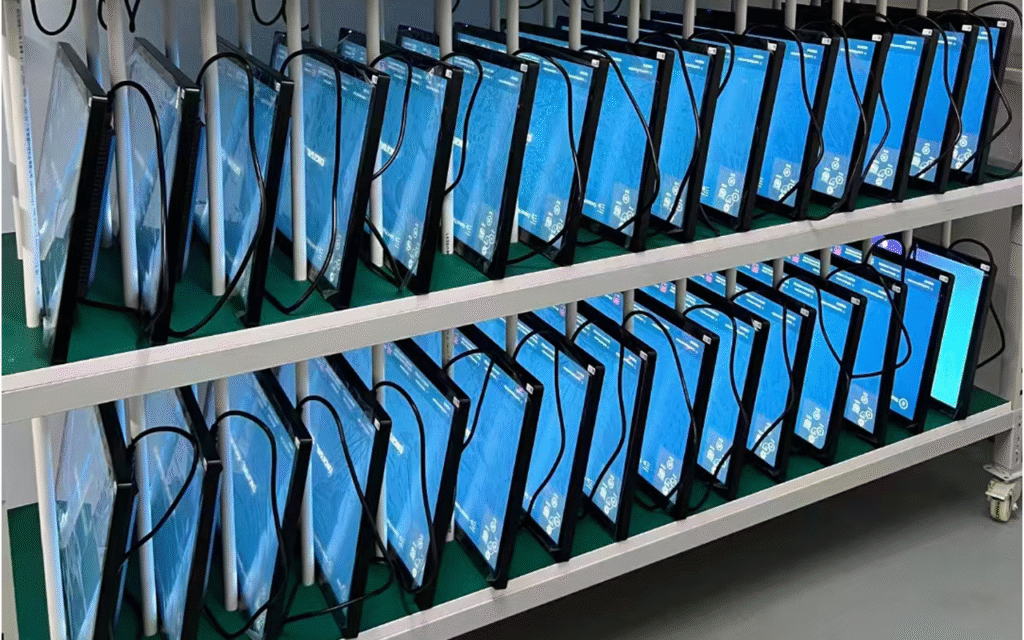
Step 5: Aging Test (Burn-In Test)
One of the most important stages in commercial electronics manufacturing is the aging test.
After assembly, POS terminals operate continuously for extended periods.
Typical aging tests last:
- 8 hours
- 24 hours
- 48 hours
- 72 hours (for selected projects)
During this process, systems repeatedly perform:
- Boot cycles
- Display operation
- Touch interaction
- Network communication
- Peripheral testing
The purpose is to identify early component failures before products leave the factory.
Most electronic failures occur during the early stages of a product’s life.
Burn-in testing significantly reduces these “infant mortality” failures.
Step 6: Reliability Testing
Beyond functional testing, professional manufacturers evaluate long-term durability.
Typical reliability tests include:
High-Temperature Test
Evaluates system stability under elevated temperatures.
Low-Temperature Test
Ensures reliable startup in cold environments.
Vibration Test
Simulates transportation conditions.
Drop Test
Evaluates packaging protection and product durability.
USB Insertion Test
Commercial POS systems often connect scanners, printers, and payment devices.
USB connectors are repeatedly inserted and removed to verify mechanical durability.
Touchscreen Life Test
Automated equipment simulates hundreds of thousands of touch operations.
This ensures reliable long-term touchscreen performance.
Step 7: Final Quality Control (FQC)
After all functional testing is completed, finished products undergo Final Quality Control.
Inspectors verify:
Appearance
Check for:
- Scratches
- Color differences
- Assembly gaps
- Logo quality
Accessories
Confirm:
- Power adapter
- Cables
- User manual
- Mounting accessories
Product Configuration
Verify:
- CPU
- RAM
- Storage
- Operating system
- Firmware version
Every product must match the customer’s purchase order.
Step 8: Outgoing Quality Control (OQC)
Before shipment, a final inspection is conducted.
Random samples from each production batch are selected for comprehensive verification.
Inspectors review:
- Packaging quality
- Product labels
- Serial numbers
- Carton integrity
- Shipping documentation
Only after passing OQC are products approved for shipment.
Quality Control Throughout the Supply Chain
Quality extends beyond the factory floor.
Professional POS manufacturers also monitor supplier performance.
Supplier evaluations typically include:
- Material consistency
- Delivery performance
- Component reliability
- Defect rates
Long-term partnerships with qualified suppliers help maintain consistent product quality.
Traceability: Every Product Has a History
Modern manufacturing relies on traceability.
Each POS terminal is assigned a unique serial number.
Manufacturers can trace:
- Component batches
- Assembly date
- Production line
- Test records
- Firmware version
- Quality inspection history
If a field issue occurs, engineers can quickly identify the production batch and analyze the root cause.
Traceability improves service efficiency and continuous product improvement.
Continuous Improvement Never Stops
Quality control is not a one-time activity.
Manufacturers continuously analyze production data to identify opportunities for improvement.
Examples include:
- Reducing assembly errors
- Improving thermal performance
- Optimizing production efficiency
- Enhancing product reliability
- Lowering defect rates
Every production batch provides valuable feedback that helps refine future manufacturing processes.
What Buyers Should Ask Before Choosing a POS Manufacturer
If you’re evaluating a POS hardware supplier, consider asking these questions:
- Do you perform 100% functional testing?
- How long is your burn-in test?
- What quality standards do you follow?
- How do you manage incoming material inspections?
- Can you provide production traceability?
- What reliability tests do you perform?
- How do you handle quality issues after shipment?
A manufacturer that can answer these questions with a structured process is more likely to deliver consistent product quality.
Final Thoughts
A commercial POS terminal is much more than a collection of electronic components.
Its reliability depends on a disciplined quality control system that covers every stage of production—from component inspection and assembly monitoring to functional verification, aging tests, reliability testing, and final shipment inspection.
At DCAPOS, quality is built into every step of the manufacturing process.
By combining engineering expertise, standardized production procedures, and rigorous testing, we strive to deliver POS hardware that performs reliably in demanding retail, restaurant, hospitality, healthcare, and industrial environments around the world.
Reliable hardware starts with reliable manufacturing—and quality control is the foundation of both.